
 By
By 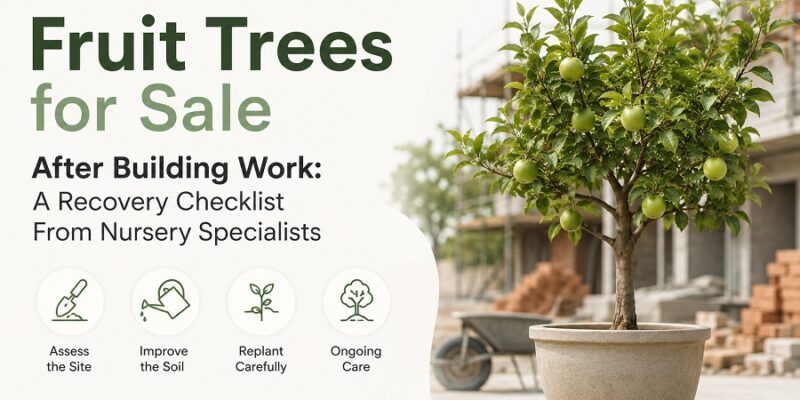
A finished extension or renovated garden often leaves a persuasive surface: new turf, clean paving, and a border filled with imported soil. Below it, the site may still carry the construction phase in wheel tracks, buried mortar, mixed subsoil, altered drainage, and narrow routes around services.
Fruit trees expose those hidden changes slowly. Roots meet the compacted layer after the first display of growth, water gathers beside a foundation, or an apparently generous planting area proves isolated from the wider soil. Recovery therefore needs investigation before planting, not rescue after decline becomes visible.
Compaction is often patchy rather than uniform, notes a nursery specialist from ChrisBowers, so one easy planting hole does not establish that the whole root zone is suitable. The specialist explains that gardeners should map delivery routes, scaffold positions, spoil heaps, new levels, and places where water now collects after rain. They advise digging several small inspection pits across the proposed area to compare depth, smell, texture, rubble, and the boundary between topsoil and compressed subsoil. This evidence determines whether the ground needs broad loosening, removal of contamination, drainage review, or simply time under protective organic cover. The specialist also points out that underground services and future maintenance access belong in the same assessment. A tree needs a connected volume of workable soil, not a decorative pocket beside paving. Their conclusion is to restore the function of the site first, then select a tree whose mature scale fits the recovered space and the routes that must remain open.
The recovery checklist begins beyond the planting hole. By reading the pattern of disturbance across the garden, a gardener can separate isolated defects from site-wide limitations and avoid hiding either beneath fresh material.
Map Where Construction Pressure Actually Fell
Heavy traffic, stored materials, mixing areas, and temporary access routes create a varied footprint that rarely matches the final garden design; the visible detail is therefore linked to the process behind it before tools or materials enter the discussion.
Problems become harder to interpret after assuming that all ground beyond the building line escaped disturbance because it now carries the same turf or topsoil finish; the apparent solution therefore creates a second problem beside the one it was meant to address.
Walk the site after rain, probe at regular intervals, and keep photographs from the building phase when they reveal buried routes or storage areas; attaching the check to a familiar route makes subtle change more likely to be noticed during a busy week.
Investigation focuses on the places most likely to influence roots instead of spreading effort evenly across unrelated parts of the garden; future work begins from a sounder structure, clearer evidence, and fewer inherited maintenance problems.
Wet-weather construction magnifies compaction in British clay, while dry work on lighter ground leaves subtler tracks that still restrict roots; short weather windows reward preparation, but they do not justify work when the tree or ground is unsuitable.
A proportionate response is to mark those zones on a simple plan and compare them with proposed trees, paths, drainage features, service runs, and retained planting; the action has a defined purpose, a visible review point, and a sensible reason to stop.
Good judgement in post-construction soil recovery comes from several modest signals rather than one dramatic clue; for post-construction soil recovery, soil, access, growth, weather, and timing should support the same explanation before an intervention becomes larger or difficult to reverse.
Look Below Imported Topsoil
A dark surface layer can improve appearance and early rooting while concealing a sharp compacted boundary, rubble, lime-rich waste, or smeared subsoil below; this gives the later decision a clear baseline instead of relying on one attractive or alarming moment.
The next deliberate move is to open several narrow pits deep enough to inspect transitions and test whether roots and water have routes into the surrounding ground; the sequence makes follow-up straightforward and leaves the cause of any improvement easier to identify.
The most misleading response is digging one oversized planting hole and filling it with rich material, which risks creating an isolated pocket with different drainage and settlement; the tree loses useful options while the gardener gains little dependable information in return.
Winter rain makes perched water easier to detect, while summer dryness reveals hard layers that resist penetration despite a friable surface; the same nominal month can describe very different plant conditions between a sheltered town garden and an exposed plot.
Compare pits rather than relying on one sample, remove harmful debris, and keep sound excavated soil in layers when broader cultivation is justified; keeping the inspection reachable ensures that good intentions survive wet days, holidays, and competing tasks.
A useful margin is part of post-construction soil recovery, not wasted effort; in post-construction soil recovery, it allows for a heavier crop, a drier month, or a missed inspection and keeps correction possible without dismantling work that is already performing well.
The proposed root zone becomes a connected soil volume whose limitations are understood before a tree depends on it; the result is understandable to another gardener and does not depend on unusually favourable conditions.
Trace New Water Routes After Rain
Roofs, patios, walls, raised levels, and compacted tracks redirect water, sometimes concentrating it exactly where a new border appears most convenient; the first conclusion remains deliberately modest, leaving enough evidence for a proportionate response.
Taken together, this part of post-construction soil recovery links timing with plant response and access; within post-construction soil recovery, the aim is not a flawless appearance, but a result stable enough to observe and modest enough to correct if later evidence changes the judgement.
British rainfall often arrives in sequences, so a pit that drains after one shower may fail when soil is already wet from previous days; aspect, shelter, soil, and recent rainfall need to be read together before the timing is judged.
The shortcut to avoid is installing a tree in the lowest attractive space and attempting to solve standing water only by adding compost to the planting hole; resisting the assumption keeps observation, intervention, and outcome connected in the right order.
Progress depends on choosing to observe at the end of sustained rainfall, identify inflow and escape routes, and distinguish temporary surface wetness from persistent saturation; the action has a defined purpose, a visible review point, and a sensible reason to stop.
Check downpipe outlets, paving falls, retaining edges, and neighbouring levels, then seek appropriate drainage advice where water has no safe route; attaching the check to a familiar route makes subtle change more likely to be noticed during a busy week.
The planting position is chosen with real hydrology in view and roots are not asked to act as a remedy for a construction defect; this protects the original purpose of the planting while leaving room for small later adjustments.
Rebuild Structure Without Forcing Fertility
Construction-damaged soil usually needs air, connected pores, biological recovery, and protection from repeated traffic before it needs a strong feeding programme; this turns a broad instruction into a condition that can be checked again after growth or weather changes.
Roots meet a stable, aerated environment and the future tree develops in soil restored for function rather than appearance alone; the benefit remains visible after the immediate concern has passed and routine care resumes.
Before selecting fruit trees for sale for a recently built or renovated plot, buyers should confirm that the intended root zone, drainage route, and mature canopy space have genuinely recovered from construction use.
Autumn mulching and winter protection suit many British schedules, but cultivation on saturated soil can undo months of gradual recovery; a review after the next meaningful spell of weather is more useful than treating the whole season as uniform.
There is also a household test for post-construction soil recovery: the arrangement has to work on wet days, during harvest pressure, and when a routine check is delayed; a post-construction soil recovery plan that survives only an ideal weekend is not yet a practical one.
The assumption that deserves resistance is rotavating wet clay or adding concentrated fertiliser to stimulate quick top growth while deeper structure remains dense and poorly aerated; the apparent solution therefore creates a second problem beside the one it was meant to address.
Use ground cover, boards on defined access routes, and repeatable infiltration observations to see whether structure improves across seasons; keeping the inspection reachable ensures that good intentions survive wet days, holidays, and competing tasks.
The sound intervention is to loosen suitable ground across a broad area when conditions allow, add surface organic matter, and keep machinery and foot traffic off the recovering zone; the sequence makes follow-up straightforward and leaves the cause of any improvement easier to identify.
Keep Services and Maintenance Routes Visible
New gardens contain drains, cables, inspection covers, wall footings, heat-pump clearances, and access needs that a mature tree must not obstruct; read in sequence, the observation keeps cause and symptom from being folded into the same assumption.
A useful course of action is to confirm service locations, protect required working widths, and test whether ladders, barrows, mowers, and contractors retain practical routes; the action has a defined purpose, a visible review point, and a sensible reason to stop.
Across a complete season, post-construction soil recovery moves from preparation to observation and then to review; in post-construction soil recovery, keeping those stages distinct prevents every new symptom from reopening the entire decision and helps each action answer a question established beforehand.
Narrow British side passages and compact urban plots intensify these conflicts, especially where one route serves the whole rear garden; local observation should therefore carry more weight than a date copied unchanged from a national calendar.
Include underground and overhead constraints on the site plan and review them against mature spread rather than the supplied size; attaching the check to a familiar route makes subtle change more likely to be noticed during a busy week.
Later correction is often created by planting over an unknown line because the young canopy seems small, leaving future roots and branches in conflict with essential maintenance; the tree loses useful options while the gardener gains little dependable information in return.
The tree contributes to the renewed garden without making inspection, repair, harvest, or ordinary movement needlessly difficult; the outcome supports the current season without borrowing strength, access, or flexibility from the next one.
Use a Recovery Season When Evidence Is Incomplete
Delaying planting for one growing season is useful when the site still needs to reveal drainage, weed pressure, settlement, or the response to soil protection; its value lies in separating what the gardener sees now from what still needs to be confirmed.
The long view of post-construction soil recovery separates permanent choices from seasonal responses; within post-construction soil recovery, position and structure deserve caution, while small adjustments remain available as growth, crop weight, and ordinary weather test the original plan.
Planting begins with fewer unknowns, a clearer maintenance route, and a site capable of supporting long-term establishment; the tree, site, and household routine finish in better agreement than a short-term cosmetic answer provides.
Set decision dates for soil checks and tree selection so delay remains an active investigation rather than indefinite postponement; keeping the inspection reachable ensures that good intentions survive wet days, holidays, and competing tasks.
The decision becomes workable when gardeners sow a manageable cover, mulch selected areas, monitor moisture, and record how the ground behaves through both wet and dry periods; the sequence makes follow-up straightforward and leaves the cause of any improvement easier to identify.
One British year provides contrasting conditions but should still be read cautiously when weather is exceptionally wet, dry, warm, or cold; the decision belongs to the actual site, where ordinary variation is part of the evidence rather than an inconvenience.
The avoidable weakness in the plan is rushing to fill the final plan because an empty space feels unfinished, then adapting every later choice around a struggling tree; resisting the assumption keeps observation, intervention, and outcome connected in the right order.
A recovered site should prove itself through ordinary weather and ordinary use. Water leaves by a known route, the soil remains workable beyond one amended pocket, access to services is protected, and the proposed root zone is no longer crossed casually by machinery or feet. Only then does planting complete the building project rather than conceal its unfinished effects. A season spent observing the ground is a modest delay beside the years during which a well-positioned tree should occupy it.







Comments